
Table of Contents
- Editor’s Note
- Key Takeaways
- Why Monaco Is A Strategic Business Domicile For High Net Worth Entrepreneurs
- Choosing The Right Business Structure For Sole Trader SURL SARL Or SAM
- How To Register A Company In Monaco The Step By Step Process
- Opening A Monaco Bank Account What The Process Really Requires
- Preparing For Monaco Residency What Business Owners Need To Know
- How Monaco Business Angels Supports Founders And Investors Establishing A Monaco Presence
- Frequently Asked Questions
- The Bottom Line On Monaco Company Registration
At Monaco Business Angels, we understand that relocating to Monaco and registering a company is not only an administrative process — it is a strategic life and business decision. Registering a Monaco company involves choosing between four structures — sole trader, SURL, SARL, or SAM — then opening a Monaco bank account and, if desired, applying for Monaco residency. We provide full relocation services, trusted local introductions and insider guidance to assist you through the entire company registration journey, from your first idea to a fully established Monaco-based structure.Registering a Monaco-based company, opening a local bank account, and planning for Monaco residency all require clear steps, strong documentation, and reliable references. This guide connects those elements so you have a well-linked, well-sourced path into the Principality, based on official Monaco portals and respected international data.
Alt text: “Sylwia-Kaminska-Company-Registration-Relocation-services.png”
Introduction
Monaco is known for its prestige, safety, and concentration of wealth, but it is also a serious business center for high-net-worth entrepreneurs, family offices, investors, brokers, consultants, and international founders. Rules are precise, information is spread across several sites, and poorly prepared files can slow or block your plans.
In the pages below you will find:
How to choose between sole trader, SURL, SARL, and SAM structures
How Monaco company registration, banking, and residency interact
What Monaco banks, ministries, and residency officers check in practice
Throughout, you will see references to Monaco government portals, IMSEE, the OECD, and leading private banking sources so your structure, tax position, and banking choices rest on verifiable facts.
Tip: Treat your Monaco project as one integrated plan—company, bank, and residency—rather than three separate tasks. The same documents, story, and references support all three.
Key Takeaways
Before diving into detail, it helps to see the main advantages and decisions at a glance. These points frame how tax, structure, banking, residency, and Monaco Business Angels fit together.
Monaco’s personal tax regime is extremely attractive for residents. There is no personal income tax, no wealth tax, and no inheritance tax between direct heirs. Wealth X notes that Monaco has the highest density of millionaires globally, which feeds strong Monaco wealth management, family office, and private client services.
Four main business structures exist for entrepreneurs. Sole trader and SURL suit solo activities, while SARL and SAM better match Monaco luxury businesses, holding entities, and institutional projects. Choosing the right format early avoids expensive restructurings and legal amendments later.
Banking in Monaco is selective. Account opening often takes longer than the company registration itself. Banks expect a clear banking profile, documented source of funds, and a coherent business plan. A Monaco bank account is typically required both for share capital and for applicants planning residency.
Company registration and residency are linked in practice but separate in law. A company does not give automatic residence rights. Residency requires suitable accommodation, proof of funds, and a clean personal record. Monaco Business Angels fits into this picture by providing a KYC-compliant environment, access to investors, and introductions to trusted local advisors.
Why Monaco Is A Strategic Business Domicile For High Net Worth Entrepreneurs

Alt text: “Entrepreneur reviewing business documents in Monaco office overlooking harbor”
Monaco functions as a strategic base for high-net-worth entrepreneurs because it combines fiscal advantages, safety, and access to capital in a small, highly connected jurisdiction. The Principality covers only 2.02 square kilometers, yet hosts a dense Monaco business hub of investors, family offices, and internationally mobile founders.
Key features include:
Personal tax advantages: no income tax for residents, no wealth tax, and favorable inheritance rules between direct heirs
High regulatory standards: Monaco follows OECD information-exchange standards and EU-style AML rules, operating as a well-supervised financial center rather than a secrecy haven. The OECD confirms that Monaco now meets global transparency standards after several reforms.
Strong infrastructure: Nice Airport offers fast links to London, Paris, Dubai, and New York. Locally, Monaco private banking, family office services, and specialist legal and accounting firms support complex international profiles.
For investors and founders looking to build a Monaco investment platform, networks such as Monaco Business Angels help connect deal flow across sectors including technology, gaming, real estate, and environmental projects.
What Monaco’s Tax Framework Actually Means For Your Business
Monaco’s tax system looks simple, but business owners need to understand several thresholds.
For individuals with Monaco residency, there is:
No personal income tax
No tax on private capital gains
No inheritance tax between parents and children
These points are confirmed on the Monaco government portal Service Public and are a key reason many HNW and UHNW individuals relocate.
For companies:
Corporate income tax is 25% only if more than 25% of turnover is generated outside Monaco. Many service companies operating mainly with Monaco clients stay outside this tax, when structured correctly.
VAT follows the French model, with a standard 20% rate and reduced rates of 10%, 5.5%, and 2.1%, as set out on monentreprise.gouv.mc. That familiarity helps cross-border businesses integrate Monaco into existing European operations.
Tip: Before filing, map your expected client base by country. This simple exercise helps you understand whether your company will cross the 25% foreign turnover threshold and face corporate tax.
Choosing The Right Business Structure For Sole Trader SURL SARL Or SAM

Alt text: “Four organized document folders representing Monaco business structures on marble desk”
Choosing the right Monaco business structure means aligning capital, liability, and governance with your objectives. The four main options are:
Sole trader (Entreprise Individuelle)
SURL (single-shareholder SARL)
SARL (standard limited liability company)
SAM (joint stock company)
Solo founders handling lower-risk services often start as a sole trader or SURL, while those seeking external capital usually opt immediately for a SARL or SAM. Monaco Business Angels frequently sees founders start lean and formalize into a société structure as deal flow and outside investment grow.
Sole Trader Entreprise Individuelle And SURL Entry Level Structures For Solo Founders
The sole trader (Entreprise Individuelle) is the most straightforward way to operate a business in Monaco:
No minimum capital
Low Trade and Industry Registry fee (about €55 per monentreprise.gouv.mc)
For non‑Monegasque residents, permit approval typically takes 2–4 weeks
However, the main risk is unlimited personal liability: all personal assets stand behind business debts and claims. For HNW individuals, this rarely fits higher‑value mandates or activities with staff, leases, or significant contracts.
A SURL, the single‑member version of a SARL, adds:
Minimum share capital of €15,000
Limited liability protection, capping exposure at the amount of capital
A more reassuring framework for banks, partners, and clients
Both sole traders and SURLs:
Face the same 25% corporate tax rule when more than 25% of revenue comes from outside Monaco
Must pay social security contributions via CAMTI and CARTI; IMSEE publishes reference schedules with fixed annual bands
For many solo operators, this mix of fixed charges, limited liability (for SURL), and relatively simple bookkeeping keeps the cost base predictable.
SARL And SAM The Societe Structures For Established And Institutional Business
The SARL is the standard limited liability company for Monaco trading and holding structures:
At least two shareholders (individuals or companies, resident or non‑resident)
Minimum share capital of €15,000, fully paid
A natural person as managing director
Incorporation typically within about three months
Articles of Association may be signed privately, and beneficial owners remain off the public register, though advisors and banks must identify them under AML rules. According to IMSEE, SARLs represent a significant share of active commercial entities in Monaco. Many angel‑backed startups and family offices choose SARLs because they are familiar to European investors and flexible for shareholder agreements.
The SAM is a joint stock company suited to larger or regulated Monaco business operations, such as finance, asset management, or substantial trading houses:
Same €15,000 minimum capital on paper, but higher overall costs
Notarial deed and Ministerial approval required
Board of directors subject to rules such as the limit of eight commercial board seats per person, noted by the Monaco Government
In practice:
SARL: usually sufficient for angel or family‑office backed ventures
SAM: preferred where institutional investors, financial licenses, or multi‑country structures are planned
Monaco Business Angels often helps portfolio founders decide between SARL and SAM when preparing for later funding rounds or regulated activities.
Monaco Business Structure Comparison At A Glance
To see the trade‑offs more clearly, use the table below as a quick reference.
| Feature | Sole Trader | SURL | SARL | SAM |
|---|---|---|---|---|
| Minimum shareholders | 1 | 1 | 2 | 2 |
| Minimum capital | None | €15,000 | €15,000 | €15,000 plus higher fees |
| Liability | Unlimited personal | Limited to capital | Limited to capital | Limited to capital |
| Formation deed type | Simple forms | Private deed | Private deed | Notarial deed |
| Government approval | Business permit | Business permit | Business permit | Ministerial Order plus permit |
| Best fit use case | Freelancers, small advisors | Solo founders seeking protection | Standard trading and holding | Large or regulated enterprises |
| Typical timeline | 2–8 weeks | Around 3 months | Around 3 months | Longer than 3 months |
Formation costs vary by provider, but SARL packages commonly start near €6,900 for the first year, according to Monaco‑focused firms cited by PwC. Corporate account opening fees at institutions such as Société Générale Private Banking Monaco can reach about US$3,500, based on data from Société Générale Private Banking. All structures must pay social security, file VAT where relevant, and keep records for at least ten years, as highlighted by Monaco’s Department of Tax Services.
How To Register A Company In Monaco The Step By Step Process
Monaco company registration follows a defined series of steps, from business permit to final registration and ongoing filings. Because banks, landlords, and residency officers all cross‑check your documents, a clear sequence and a consistent story are essential.
Start by:
Defining your activity precisely and checking whether it needs extra sector approval (finance, real estate, healthcare, food, transport, etc.)
Showing that your professional background, client base, and financial means match the proposed business
Considering how your Monaco company will support, but not replace, a possible residency application
Working with a Monegasque lawyer, accountant, or a network like Monaco Business Angels often shortens timelines, as they already know local procedures and contacts.
The 10 Step Registration Sequence Every Monaco Founder Must Follow
The steps below apply whether you choose a sole trader, SURL, SARL, or SAM.
Check sector approvals. Confirm on monentreprise.gouv.mc whether your activity (e.g., finance, insurance, real estate, media, healthcare, food, transport) needs additional authorization.
Choose and clear a business name. Sole traders may use their own name or a trade name; SARLs and SAMs must include the legal form. The Trade and Industry Registry can confirm availability.
Prepare personal documents. Collect passports, birth certificates, recent criminal record extracts, and proof of business address in Monaco (lease or domiciliation). Translate and legalize documents where required.
Draft Articles of Association. For SURL, SARL, and SAM, set out share capital, company objects, and governance. For a SAM, a Monegasque notary must prepare a formal deed.
Submit the business permit request. File the activity declaration with the Direction du Développement Économique. Foreign founders always need this step. The Monaco Government notes that the Minister of State usually replies within a few weeks.
Open a temporary capital account. For SURL, SARL, or SAM, deposit at least €15,000 with a Monaco bank and obtain a capital deposit certificate for the registration file.
Register with the Trade and Industry Registry. Once authorization and capital deposit are in place, file with the registry to obtain your company number and trigger publication in the Journal de Monaco. Sole traders must do this within one month of permit approval.
Apply for a NIS number. Obtain a statistical identifier from IMSEE, which many service providers require before opening phone lines, utilities, or other contracts.
Register for tax and social security. Sign up with the Department of Tax Services for VAT and, where applicable, corporate income tax. At the same time, enroll managers and self‑employed persons with CAMTI and CARTI; IMSEE links to these funds.
Set up accounting and compliance routines. Implement invoicing, bookkeeping, and document-retention processes (minimum ten years) and keep registry details updated when addresses, directors, or activities change.
Tip: Keep a single digital folder structure for “Company”, “Banking”, and “Residency”. The same documents are requested repeatedly; organized files save weeks of back‑and‑forth.
Opening A Monaco Bank Account What The Process Really Requires
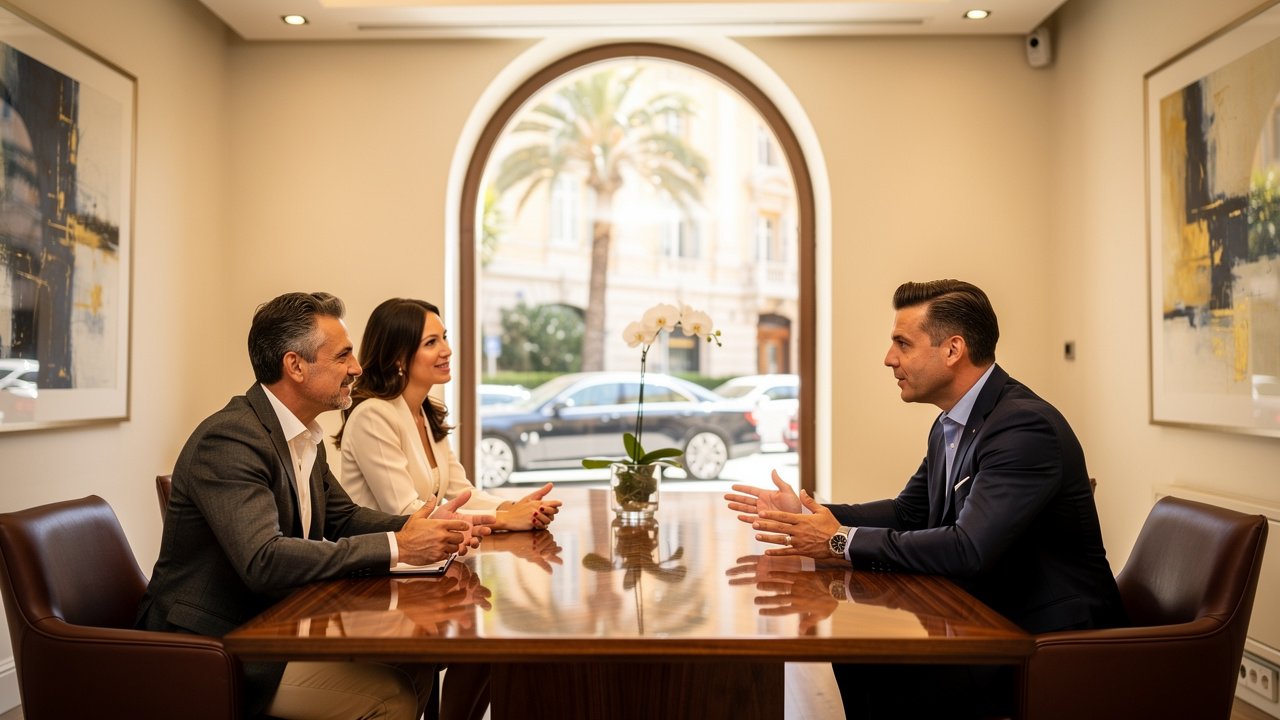
Alt text: “Professional banker meeting with clients inside Monaco private bank branch”
Opening a Monaco bank account is often more demanding than submitting company forms, especially for foreign founders. Banks primarily serve private clients and family offices with high expectations on risk control, so every new relationship is checked in depth.
Monaco law gives any legitimate business the right to a bank account, with appeals possible to the Department of Budget and Treasury if a bank refuses. In practice, however, banks maintain strict admission policies and minimums. The Association Monégasque des Activités Financières notes that Monaco banks manage more than €100 billion of assets, focusing on quality rather than volume.
For SURL and SARL incorporation, the minimum share capital must be placed with a Monaco credit institution before the Trade and Industry Registry finalizes registration. Discussions with banks should therefore start while the business permit is still under review.
What Monaco Banks Actually Look For In A Business Banking Application
Monaco banks typically review three core areas in each application: identity, funds, and business rationale.
Company documents. Banks expect draft or final Articles of Association, shareholder lists, and later the RCI certificate and NIS number. For sole traders, they ask for proof of registered activity and links to official records.
Personal files for all key individuals. Directors, shareholders, and beneficial owners must provide passports, proof of address, CVs, and bank statements showing the build‑up of wealth. A clear source of funds and source of wealth narrative is essential.
Business plan. Even for holding or Monaco investment platform entities, banks ask for a concise plan: expected transaction flows, main counterparties, and why the activity fits the founder’s track record and Monaco’s profile.
Fees and minimums. Opening fees around US$3,500 are common at leading private banks, according to Société Générale Private Banking. Many institutions also expect meaningful ongoing balances, particularly from Monaco high‑net‑worth relocation clients.
Tip: Ask your lawyer, accountant, or Monaco Business Angels contact for warm introductions. When a bank already knows a professional in your chain, internal approvals tend to move faster.
Preparing For Monaco Residency What Business Owners Need To Know

Alt text: “Luxury Monaco apartment with terrace overlooking Mediterranean Sea for residency”
Applying for Monaco residency runs alongside, but separate from, company registration. Residency provides personal tax advantages and embeds you in the local community, while the business permit simply allows you to operate a commercial activity.
The Sûreté Publique assesses:
Housing in Monaco (owned or rented)
Financial means sufficient to live without public support
Personal conduct and criminal record
The Service Public portal outlines these requirements. Many HNW and UHNW applicants coordinate business registration and residency as part of one broader wealth and lifestyle plan.
US citizens and green card holders remain taxable in the United States on worldwide income, so they need specialist advice on interaction between US rules and a Monaco base. In all cases, a credible Monaco-based business strengthens residency files by showing a real economic link to the Principality.
The Six Practical Steps Toward Monaco Residency For Business Owners
Use the steps below as a practical checklist; always confirm current rules before applying.
Secure accommodation. Buy or rent property in Monaco that meets minimum size and lease‑length rules. The market is among the most expensive in the world; Knight Frank ranks Monaco prime prices above many global capitals.
Open a personal Monaco bank account. Place a reasonable level of assets or income streams to show that your daily life will be based in Monaco and that you can meet living costs.
Gather police records. Obtain recent criminal record extracts and any required police clearance letters, then translate and legalize them where necessary so they are easy for officers to review.
Apply for the residence card. File for a carte de résident with the Sûreté Publique. Initial cards often last one year, with renewals moving to three‑year and then ten‑year cards. The Monaco Government portal provides forms and appointment procedures.
Show real presence. Spend significant time in Monaco each year. Authorities can check utility bills, school attendance, and other signs of daily life to confirm that Monaco is your main home.
Plan your former country’s tax exit. Work with cross‑border tax advisors—especially if you are American—to manage filings, treaties, and structure choices. Combining Monaco wealth management with international tax input helps avoid double taxation.
For foreign founders who plan to both live and work in Monaco, business permits and residency cards should be planned together to keep your overall story consistent.
How Monaco Business Angels Supports Founders And Investors Establishing A Monaco Presence

Alt text: “Professionals networking at exclusive Monaco Business Angels event overlooking harbor”
Monaco Business Angels supports founders and investors who want a Monaco presence by combining vetted deal flow with practical guidance on local setup.
The network:
Brings together angel investors, family offices, and institutional players with early‑ and growth‑stage founders
Operates a fully KYC‑compliant platform, so identity and source‑of‑funds checks match Monaco’s regulatory climate
Connects members with Monaco‑focused lawyers, accountants, and private banks who understand sole trader vs SARL, SURL for solo entrepreneurs, and SAM practice for larger ventures
For Monaco private clients and Monaco luxury business founders, these advisors help design structures that meet investor expectations and family office goals. In many cases, introductions from Monaco Business Angels speed up banking, refine business plans, and open doors to co‑investors for Monaco business setup and banking.
Tip: When presenting to Monaco Business Angels, prepare the same quality of documents you would use for banks or ministries. A clear, consistent file makes every later step easier.
Frequently Asked Questions
This section addresses common questions from founders and investors exploring Monaco company formation and relocation.
Can A Foreigner Register A Company In Monaco?
Yes. Foreigners can register any of the main Monaco company types (sole trader, SURL, SARL, SAM). All non‑Monegasque founders must obtain a business permit from the Minister of State before starting activity, and some sectors (finance, healthcare, real estate, media, etc.) require additional licenses.
What Is The Difference Between A SARL And A SURL In Monaco?
A SARL needs at least two shareholders, while a SURL is the single‑shareholder version for one owner‑operator. Both provide limited liability and require a minimum of €15,000 share capital. Timelines, tax rules, and core filing obligations are broadly similar.
How Long Does It Take To Register A Monaco Company?
For a sole trader, permit approval usually takes 2–4 weeks, with up to one month more for Trade and Industry Registry filing. SARL and SURL formations often take around three months from first application to final documents. SAM formations can take longer due to notarial deeds and Ministerial Orders.
Does Registering A Monaco Company Automatically Grant Residency?
No. A business permit allows you to run a commercial activity but does not give the right to live in Monaco. Residency is a separate process with the Sûreté Publique, based on housing, financial means, and personal background.
What Are The Minimum Capital Requirements For Monaco Companies?
Sole trader: no minimum capital, only a modest registration fee
SURL, SARL, SAM: at least €15,000 share capital, fully paid at incorporation
For SURL and SARL, this money must first be deposited in a Monaco bank before registry approval.
How Difficult Is It To Open A Corporate Bank Account In Monaco?
Account opening is selective rather than automatic. Banks review detailed KYC files, business plans, and proof of wealth before accepting clients. While the law grants a right to a bank account, strong preparation and introductions—often via lawyers, advisors, or Monaco Business Angels—make the process smoother.

Alt text: “SylwiaKaminska-MonacoBusinessAngels.jpg”
Full Relocation Services – Connect with Sylwia K.
The Bottom Line On Monaco Company Registration
Success with Monaco company registration comes from aligning structure, banking, and residency with your personal and business goals.
Sole trader status fits lower‑risk solo work.
SURL adds limited liability for one founder.
SARL suits most trading and holding companies.
SAM serves institutional‑scale or regulated ventures.
Monaco’s process follows a clear chain: business permit, bank account and capital deposit, incorporation and NIS number, tax and social registrations, and—where wanted—residency. At each stage, authorities and banks look for a well‑defined activity, a clean personal file, a clear banking profile, and a coherent explanation of why Monaco is the right base.
According to monentreprise.gouv.mc, founders who submit complete, well‑organized dossiers receive faster approvals and fewer follow‑up questions.
Monaco Business Angels adds an extra layer by offering a KYC‑compliant community, curated deal flow, and access to Monaco’s advisory circle. With thoughtful planning and the right partners, Monaco can serve both as a home for your business and a long‑term base for your wealth and family.