
Author Note
I was born in Poland in 1979, in a country where pipelines, ports and refineries were not abstractions but instruments of power that set prices, alliances and, at times, national survival. That experience shapes how I read Europe’s current shift. After the Ukraine war, sanctions on Moscow and Russia’s exclusion from many energy markets, and after the latest Iran–Hormuz development, Europe is not simply moving away from oil and gas. It is moving away from fragile supply chains, single‑supplier dependency and politically exposed routes. Russian pipelines through Ukraine and the Baltic have already failed that test; the Strait of Hormuz has now reminded investors that maritime chokepoints can be just as exposed. This article sets out how that realisation is rewiring Europe’s energy map and why serious capital is treating terminals, ports and storage as security infrastructure as much as energy infrastructure.
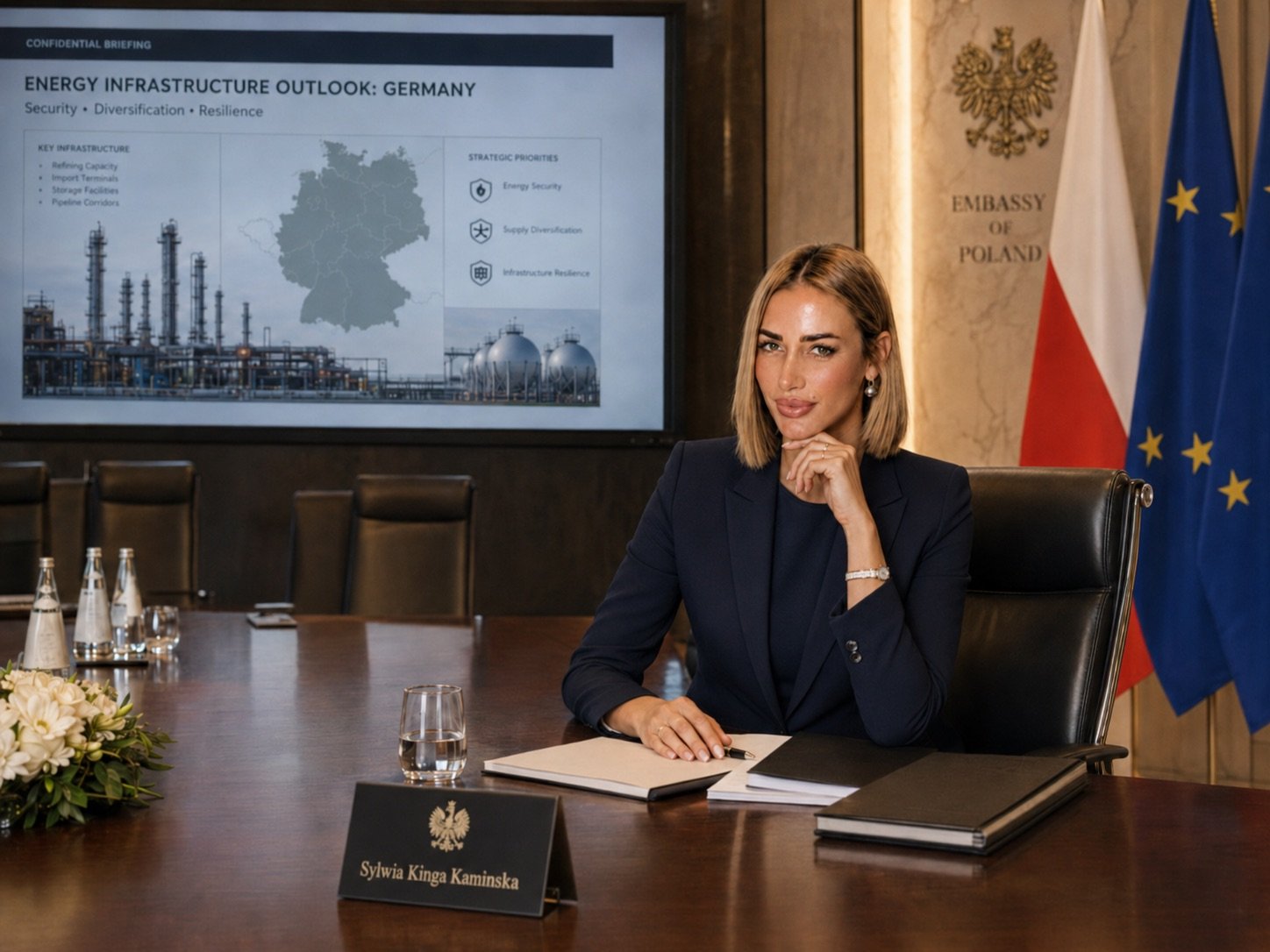
Introduction
Europe is rebuilding oil and gas supply security by replacing Russian pipelines with US LNG, Norwegian pipeline gas and new import terminals, while expanding storage and interconnector capacity across the continent. Europe’s Energy Security Reset – Oil, Gas, LNG And Strategic Infrastructure After Ukraine And Hormuz describes a shift from an era of cheap dependency to one driven by defence logic and redundancy.
For two decades, European policy assumed that cross‑border trade and long pipelines would keep hydrocarbons affordable and stable. That assumption collapsed when Russia invaded Ukraine and then used gas as a weapon. Prices spiked, inflation surged and the quiet dependence on one supplier turned into a first‑order security risk.
Sanctions, partial market exclusion and suspected sabotage of Russian routes deepened the break. In parallel, fears around potential escalation near the Strait of Hormuz showed how easily Gulf flows could be disrupted, threatening oil cargoes, LNG routes and marine insurance. Europe suddenly faced a twin lesson:
Russian pipeline dependence was a political risk.
Hormuz chokepoint exposure was a physical risk.
The emerging response is not a sudden exit from hydrocarbons. It is a move away from concentration risk—in suppliers, in routes and in critical nodes—towards a mesh of LNG terminals, crude oil terminals, refineries, ports, pipelines, storage and interconnectors treated as strategic security assets. The sections that follow map this reset, highlight key countries, and draw out the implications for policy and long‑term investors. Monaco Business Angels has been tracking this structural shift closely, helping sophisticated capital navigate the new infrastructure landscape it has created.
Key Takeaways
Russian gas has fallen from dominant to marginal in the EU mix. According to the European Commission, Russia’s share of EU gas imports dropped from around 53% in 2021 to roughly 10% by the middle of this decade. That volume has been replaced mainly by US LNG, Norwegian pipeline gas and additional flows from Qatar, Algeria and Azerbaijan, changing both routes and counterparties.
The Hormuz ceasefire framework offers price relief, not structural safety. Reporting from Reuters and statements from US and European officials describe a diplomatic framework that reopens Hormuz to tankers and LNG carriers and eases war‑risk premiums. Yet nearly a fifth of global oil and LNG still passes this narrow channel. Any renewed tension would again hit European import costs and insurance. Markets can celebrate, but policymakers are treating it as a pause in pressure, not a permanent peace.
Energy infrastructure has become part of Europe’s security perimeter. The International Energy Agency notes that wind and solar already produce more EU electricity than gas. Even so, LNG terminals, crude oil terminals, refineries, ports, pipelines, gas storage and interconnectors are now classed as critical assets. For investors, the central question is straightforward: which assets retain value when the next geopolitical shock arrives?
“You do not de‑risk a system by swapping one flag on the same pipe,” is how one senior European adviser framed the lesson after 2022.
How The Ukraine War Permanently Rewired Europe’s Energy Architecture
The Ukraine invasion turned Europe’s long‑standing Russian energy dependency into a forced, and largely irreversible, policy reversal.
By early 2022, Russia supplied about 45% of EU gas imports, roughly a quarter of EU oil and close to half of coal. Germany’s doctrine of Wandel durch Handel treated commercial ties as a stabilising tool and justified large pipeline projects such as Nord Stream 1 and Nord Stream 2. Cheap Russian gas underpinned German industry and rippled across Central Europe through district heating and power plants.
Warning signs had been visible for years. Gas cut‑offs through Ukraine in 2006 and 2009, and the annexation of Crimea in 2014, all demonstrated Moscow’s readiness to use gas for leverage. Yet several member states deepened ties to Gazprom instead of stepping back. By 2018, the Russian share of European gas supply had grown even further, while dependence on imported gas hovered around 90% of EU demand.
The full‑scale invasion in February 2022 converted this structural imbalance into a direct security crisis. Gazprom had already slowed flows and drawn down storage in 2021, helping push prices towards €300 per megawatt hour at the peak, compared with about €20 in 2020. Inflation broke double digits in multiple states, and energy‑intensive sectors—from chemicals and fertilisers to metals—cut output or weighed relocation.
According to ACER, the EU energy regulator, this shock and the explicit use of gas as a political instrument triggered a fundamental redesign of policy. Energy security moved from a technical file to the strategic core of decision‑making in Berlin, Paris, Brussels and national capitals across the bloc.
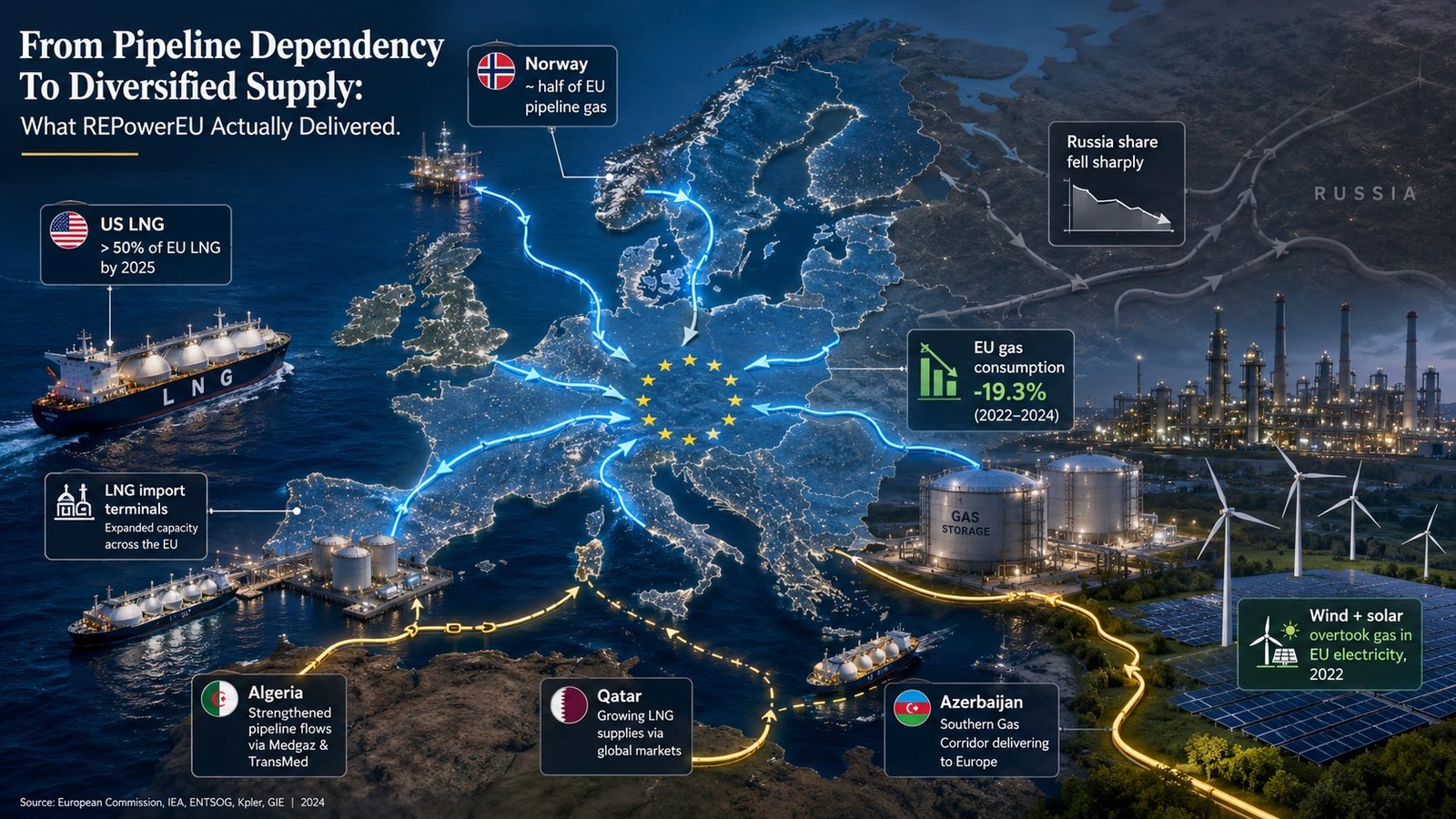
From Pipeline Dependency To Diversified Supply What REPowerEU Actually Delivered
From Pipeline Dependency To Diversified Supply What REPowerEU Actually Delivered sets out how European policy turned slogans into measurable change and what that means for long‑term security.
Launched in May 2022, REPowerEU set out to cut Russian gas use by two‑thirds within a year through demand reduction, alternative suppliers and faster deployment of renewables. According to the European Commission, EU gas consumption between August 2022 and January 2023 was 19.3% below the 2017–2022 average, beating the voluntary 15% cut target. High prices, conservation campaigns, industrial fuel switching and mild weather all contributed.
On the supply side:
Russia’s gas share in EU imports fell from more than half in 2021 to below the mid‑teens by 2025.
Norway now covers around half of EU pipeline gas, anchoring a North Sea–to–EU axis.
US LNG jumped from roughly a quarter of European LNG imports in 2021 to more than half by 2025, backed by spare liquefaction capacity and policy support from Washington.
Algeria, Qatar and Azerbaijan added volumes through Mediterranean pipelines, long‑term LNG contracts and the Southern Gas Corridor.
Coal imports from Russia ended in August 2022, followed by a ban on seaborne Russian crude in December and on refined products in early 2023. Meanwhile, wind and solar reached about 22% of EU electricity in 2022, surpassing gas for the first time, according to the International Energy Agency.
The resulting energy mix still relies on oil and gas, but no longer accepts Russian pipelines as the backbone. Instead, it rests on multiple sources, multiple routes and more flexible infrastructure—a theme that returns in every asset class considered below.
The Hormuz Dimension What The Iran Ceasefire Changes And What It Does Not
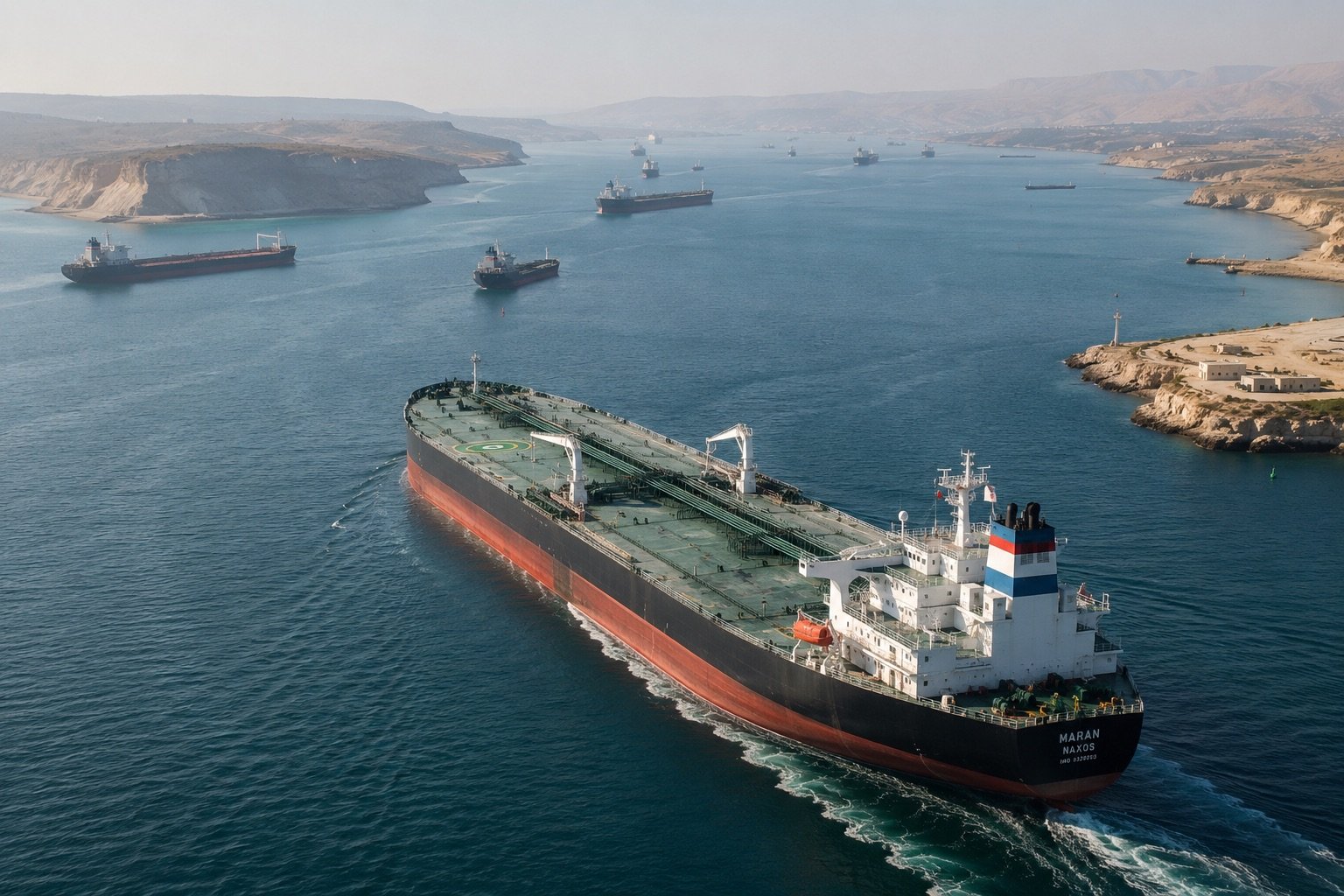
The Hormuz Dimension section examines how the Iran ceasefire framework, as reported by Reuters and confirmed in official US and European statements, affects European energy risk. It separates near‑term relief from deeper chokepoint exposure.
The Strait of Hormuz is a narrow channel linking the Gulf to wider markets. Around a fifth of global oil shipments and a similar share of LNG exports pass through this strait. Qatar, now a central LNG supplier to Europe, relies almost entirely on Hormuz, as do major crude exporters such as Saudi Arabia, the United Arab Emirates and Iraq.
In mid‑June 2026, according to White House statements cited by Reuters, US mediation produced a ceasefire framework with Iran. The agreement in principle committed all parties to keep Hormuz open to shipping and envisaged a phased lifting of US naval restrictions on Iranian ports once the detailed text was signed and verified. Oil prices dropped on the news, Asian equity indices rallied and war‑risk insurance on Gulf shipping narrowed.
European leaders, including Commission President Ursula von der Leyen, welcomed the reopening of Hormuz as vital for trade and regional stability. Yet EU officials have been careful to stress that one diplomatic step does not erase the fundamental risk of relying on a narrow maritime corridor in a volatile region. Iran’s nuclear file, missile programmes and non‑state actors across the Gulf and Red Sea all remain live sources of uncertainty.
For European buyers who substituted Russian pipeline gas with Qatari LNG, the message is uncomfortable. Diversity by supplier still leaves exposure by route if most cargoes share the same chokepoint. The ceasefire reduces the probability of short‑term disruption, but it does not deliver a guarantee extending across the investment horizon.
Why European Analysts Remain Measured Despite The Breakthrough
Why European Analysts Remain Measured Despite The Breakthrough explains why policy and investment circles read the Hormuz reopening as relief, not conclusion—and why that distinction matters for infrastructure strategy.
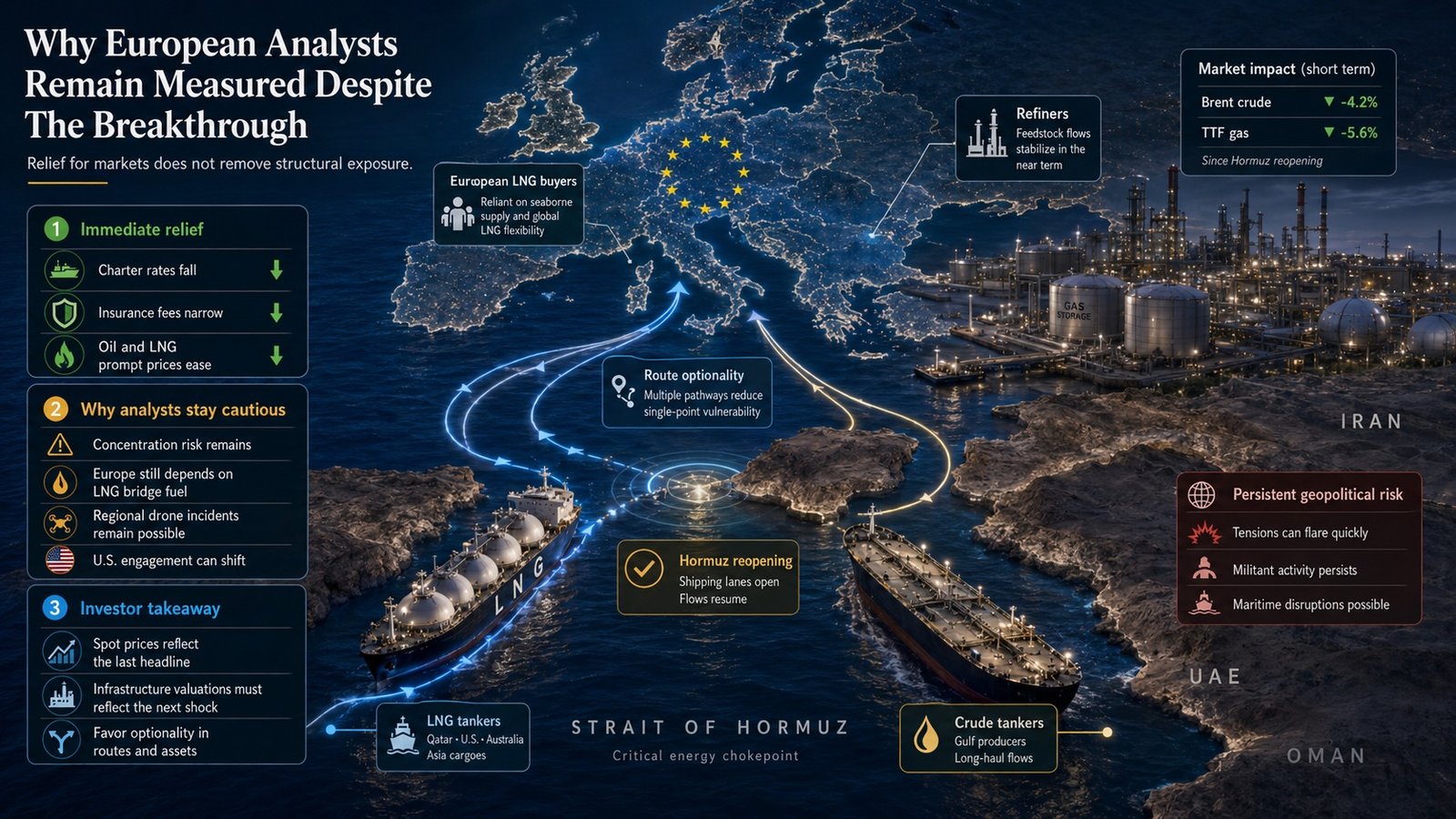
In the immediate term, lower war‑risk premiums and improved tanker access cut costs for European refiners and gas buyers:
charter rates fall;
insurance fees narrow;
prompt prices for oil and LNG ease.
For trading desks and some listed companies, this is welcome after months of elevated risk pricing.
Analysts in Brussels, Berlin and Paris, however, focus on concentration risk. Hormuz still carries much of the LNG that Europe has come to view as its bridge fuel during decarbonisation. The region remains subject to drone incidents, miscalculation between regional powers and shifts in US engagement.
For investors, this divergence between market relief and structural exposure is central. Spot prices reflect the last headline; infrastructure valuations must reflect the next shock. The Hormuz deal is best read as a reminder to favour optionality in routes and assets, not as an excuse to relax.
Investment tip: “Treat every chokepoint as a potential credit event. Structure portfolios so that no single strait, pipe or plant can decide your year.”
LNG Terminals, Pipelines, And Storage Europe’s New Strategic Asset Class
Gas import and transport assets have undergone a fundamental reclassification since 2022: they are no longer low‑profile utilities but anchors of national security, and that shift has permanently altered both their risk profile and their return characteristics.
Before 2022, many European LNG terminals ran below nameplate capacity and were concentrated in Spain, France and the United Kingdom. Germany, the continent’s largest gas market, had no LNG import terminal at all, preferring long‑term Russian pipeline contracts to flexible seaborne cargoes.
The Ukraine war reversed that preference in a single heating season:
Germany fast‑tracked floating storage and regasification units (FSRUs), bringing Wilhelmshaven online in under 200 days and reaching several operational sites within a year.
The Netherlands pushed the Gate terminal towards full utilisation and expanded floating capacity in Eemshaven, reinforcing its role as a North‑West European hub.
Italy, Greece, Finland and Poland expanded or approved new capacity at Revithoussa, Świnoujście, Alexandroupolis and other ports.
Underground gas storage moved from a commercial afterthought to a strategic buffer after Gazprom drew down European stocks in 2021. According to Eurostat, EU gas storage has been filled to more than 90% ahead of recent winters under new minimum rules. Salt caverns, depleted fields and aquifer sites now sit inside national security planning, supported by regulated tariffs and mandatory fill targets that support stable revenues.
For investors, these assets now sit between classic infrastructure and defence‑related assets:
Revenues often come from long‑term capacity bookings, index‑linked fees or regulated returns, reducing direct exposure to daily price swings.
Political backing is strong, but scrutiny around safety, climate impact and local acceptance has intensified.
Holding periods are long, but cash flows can be relatively predictable compared with many other sectors.
Two asset groups draw particular attention:
LNG import terminals now serve as physical entry points for non‑Russian gas and as potential hubs for future hydrogen or ammonia imports. Many have been designed to handle additional molecules over time, giving investors current income from gas and an embedded option on lower‑carbon value chains.
Underground gas storage provides seasonal balancing that smooths winter peaks, limiting both price volatility and blackout risk. Mandated minimum fill levels create predictable demand for storage space, improving bankability and allowing longer debt tenors. For policymakers, these caverns are physical insurance policies located under national soil.
Pipelines, Interconnectors, And The Refinery Adaptation Challenge
Pipelines, Interconnectors, And The Refinery Adaptation Challenge looks beyond tanks and caverns to the steel in the ground that carries gas and oil—and how it is being reshaped to lock in the shift away from Russia.
New and upgraded routes such as:
the Baltic Pipe linking Norwegian gas to Poland,
the Trans Adriatic Pipeline (TAP) delivering Caspian gas into Greece and Italy, and
Baltic and Central European interconnectors, including links between Poland, Slovakia, Czechia and the Baltic states,
have turned former end‑users of Russian gas into transit and hub countries for Norwegian, Azerbaijani and LNG‑sourced volumes. Reverse‑flow capacity now allows gas to move from LNG‑rich coasts on the North Sea and Baltic towards Central and Eastern Europe when needed.
The Nord Stream explosions in September 2022 highlighted the vulnerability of subsea pipelines to physical attack. New North Sea and Baltic projects therefore place greater emphasis on monitoring, redundancy, naval presence and closer coordination with NATO. That not only raises cost, it also shapes the type of investor willing to hold such assets.
Refineries across Central and Eastern Europe face a parallel adaptation. Facilities such as PCK Schwedt in Germany, INA in Croatia and MOL refineries in Hungary and Slovakia were designed for Russian Urals crude. Shifting to blends from the North Sea, the United States, the Middle East and North Africa requires:
new blending strategies,
additional desulphurisation capacity,
in some cases, reversed or new crude pipelines.
These upgrades demand heavy capital but open the way to more flexible feedstock and closer alignment with sanctions and supply security.
Strategic deep‑water ports in the Baltic, Mediterranean and North Sea—from Gdańsk and Rotterdam to Trieste and Piraeus—now sit at the centre of this rearranged flow map. Terminals capable of hosting very large crude carriers or large LNG vessels act as gateways for transatlantic and Middle Eastern cargoes. As a result, valuations for port‑linked storage, jetties and related logistics have risen well above pre‑2022 levels in many transactions.
Key Countries Reshaping Europe’s Energy Map
A handful of European states and external suppliers now determine the success or failure of the continent’s energy security reset—and understanding each one is essential to reading where capital and policy are heading next.
Germany has moved from the symbol of Russian gas faith to the symbol of emergency diversification. Its rapid LNG build‑out, temporary recourse to additional coal capacity and procurement of US and Qatari LNG have changed how Berlin and Brussels think about industrial policy. German manufacturers now treat gas price and security as core variables in investment decisions.
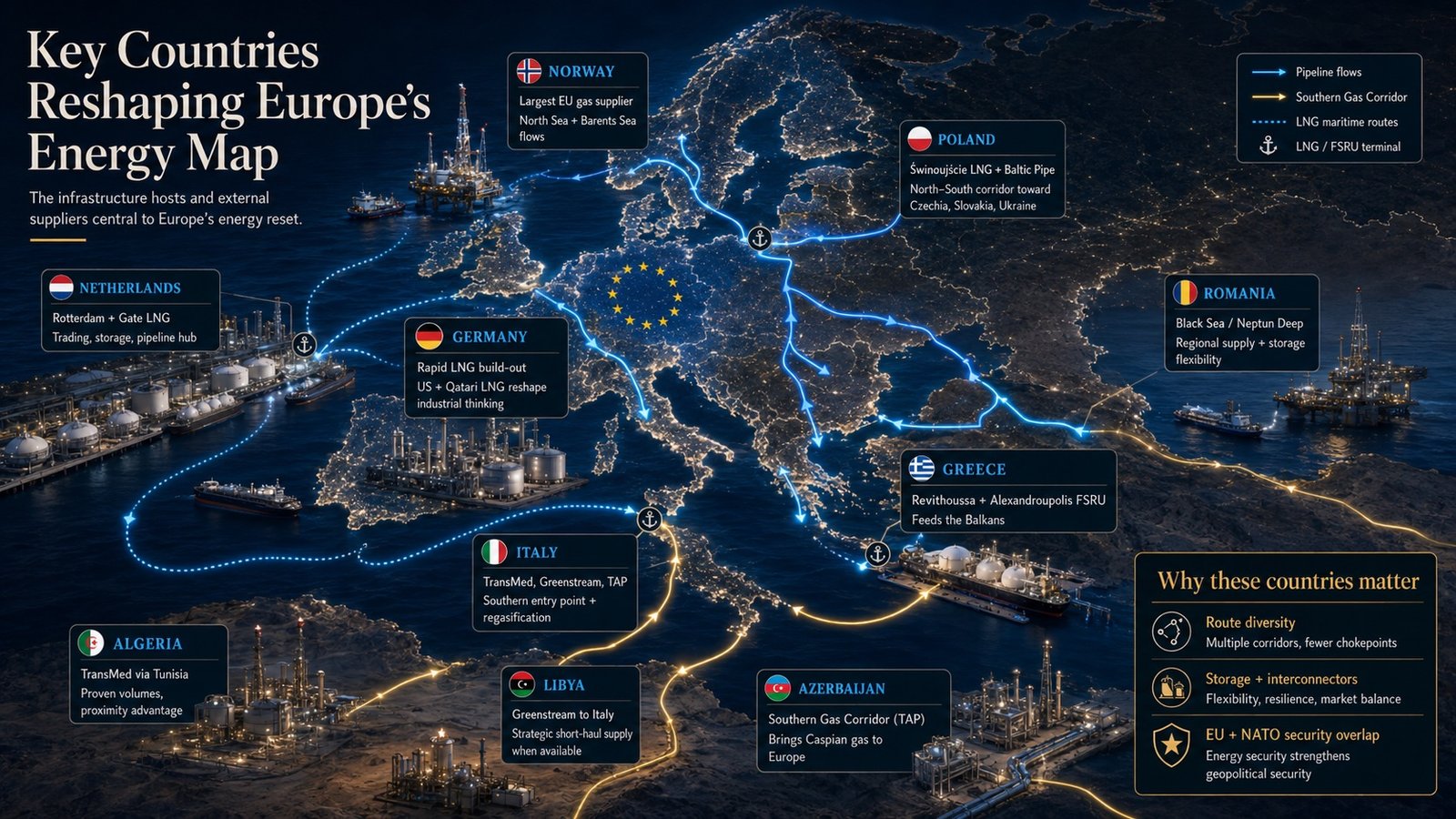
Poland has gained weight through early scepticism about Russian pipelines and timely infrastructure. Warsaw opposed Nord Stream 2 for years and invested in the Świnoujście LNG terminal and the Baltic Pipe to Norway. Poland now sits at the centre of a north‑south energy corridor, with capacity to send gas towards Czechia, Slovakia and even Ukraine, backed by plans for further storage and interconnector upgrades.
Norway anchors the new pipeline‑led supply axis. As the largest single gas supplier to the EU, Norwegian fields in the North Sea and Barents Sea run near capacity, with companies such as Equinor and Aker BP adjusting plans to sustain flows. Norwegian crude and condensate supply into key ports also helps European refineries adapt away from Russian grades.
The Netherlands plays a different but equally important role as a trading and logistical hub. Rotterdam’s crude and product terminals, the Gate LNG terminal and extensive storage and pipeline connections underpin much of North‑West Europe’s oil and gas trade, even as domestic gas production from Groningen declines.
Greece and Italy are at the heart of the emerging Mediterranean corridor:
Greek ports such as Revithoussa and the new Alexandroupolis FSRU feed gas into the Balkans, reducing reliance on Russian flows.
Italy receives gas from Algeria and Libya through the TransMed and Greenstream pipelines, as well as from Azerbaijan through TAP. Additional LNG regasification and storage projects strengthen Italy’s role as a southern entry point.
Romania brings the Black Sea dimension to the map. Projects such as Neptun Deep have the potential to supply Romania and neighbours in South‑Eastern Europe, reducing dependence on transit via Ukraine or Turkey. Storage sites in Romania and adjacent states add seasonal flexibility. For investors, this cluster bridges EU regulation, NATO security and significant geological resources.
The Role Of Non European Suppliers US LNG, Qatar, Norway, Algeria, And Azerbaijan
The Role Of Non European Suppliers US LNG, Qatar, Norway, Algeria, And Azerbaijan explains how external partners shape Europe’s reset and where new dependencies lie.
The United States has emerged as Europe’s main swing supplier of LNG. By late 2022, US cargoes accounted for around half of EU LNG imports and about 12% of its oil, supported by flexible contracts and broad geopolitical alignment. Long‑term offtake agreements give European buyers confidence, but they also tie European prices more closely to global LNG markets and to US domestic regulatory debates.
Qatar has consolidated its status as a low‑cost LNG producer with major expansion underway. European buyers, including utilities and industrial groups in Germany and elsewhere, have signed contracts extending beyond 2040. Yet every Qatari LNG cargo to Europe still passes through Hormuz, combining diversification by supplier with continued reliance on a single maritime channel.
Norway, though geographically in Europe, sits outside the EU and manages its own petroleum regime. Its gas now covers more than half of EU pipeline imports, feeding directly into terminals in the United Kingdom, Germany, Belgium and France. Norwegian offshore wind and potential hydrogen exports will also matter for Europe’s medium‑term decarbonisation and security mix.
Algeria and Azerbaijan play critical roles via direct pipelines:
Algeria sends gas to Spain and Italy through undersea lines that bypass more sensitive transit states and shorten shipping distances.
Azerbaijan’s Southern Gas Corridor, culminating in TAP, delivers Caspian gas into Greece and Italy, with plans to lift capacity, though finite reserves limit absolute growth.
Collectively, these suppliers illustrate a hard lesson: excluding Russian molecules has not removed geopolitics from Europe’s gas system; it has redistributed it across new partners and routes.
Renewables, Nuclear, And Hydrogen The Long Term Security Architecture
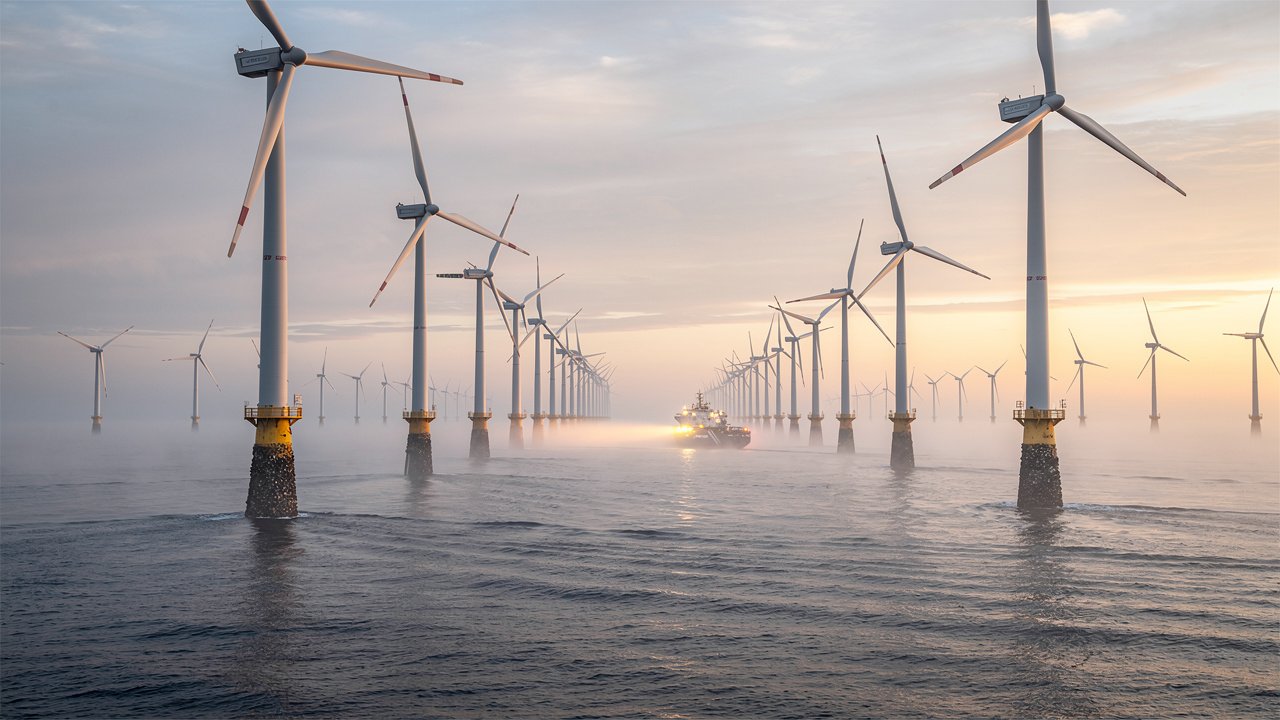
Renewables, Nuclear, And Hydrogen The Long Term Security Architecture places the fossil fuel reset inside a wider decarbonisation and security strategy.
The swift return of some coal‑fired units and the rush for LNG capacity after 2022 looked, at first, like a step backwards for climate policy. New LNG terminals carry technical lifetimes measured in decades, raising concerns about stranded assets and lock‑in.
Yet data from the International Energy Agency tell a more nuanced story:
EU energy‑related emissions still fell about 2.5% in 2022, as gas demand dropped sharply and a warm winter reduced heating needs.
Wind and solar reached around 22% of EU power output, surpassing both gas and coal.
Investment in renewable projects and grids continued at scale.
Nuclear power is regaining prominence in security debates. France remains heavily reliant on its reactor fleet and has announced plans for new builds and life‑extensions. Central European states such as Poland and Czechia view new reactors—potentially including small modular units—as industrial anchors providing low‑carbon baseload close to factories and cities.
Hydrogen and related fuels are being built into the design of the gas system itself. The European Hydrogen Backbone initiative, led by major transmission system operators, proposes re‑using large parts of the existing gas pipeline grid for hydrogen. Several new LNG terminals are being constructed with space and materials suitable for future ammonia or hydrogen imports.
Potential supply sources include:
North African green hydrogen linked to solar and wind,
Norwegian hydrogen coupled with offshore wind and gas reforming with carbon capture,
Gulf exporters seeking to ship hydrogen‑based fuels to Europe.
Energy efficiency completes this longer‑term architecture. Better building insulation, heat pumps, more efficient motors and digital grid management all lower the volume of energy required for a given level of activity. According to Eurostat, per‑capita energy use in several EU member states has already fallen below pre‑pandemic levels. For security planners, negawatts—the energy never consumed—are now as strategic as molecules delivered.
How Monaco Business Angels Positions Sophisticated Capital In This Environment
How Monaco Business Angels Positions Sophisticated Capital In This Environment describes how a discreet investment platform operates within this new energy‑security‑driven map.
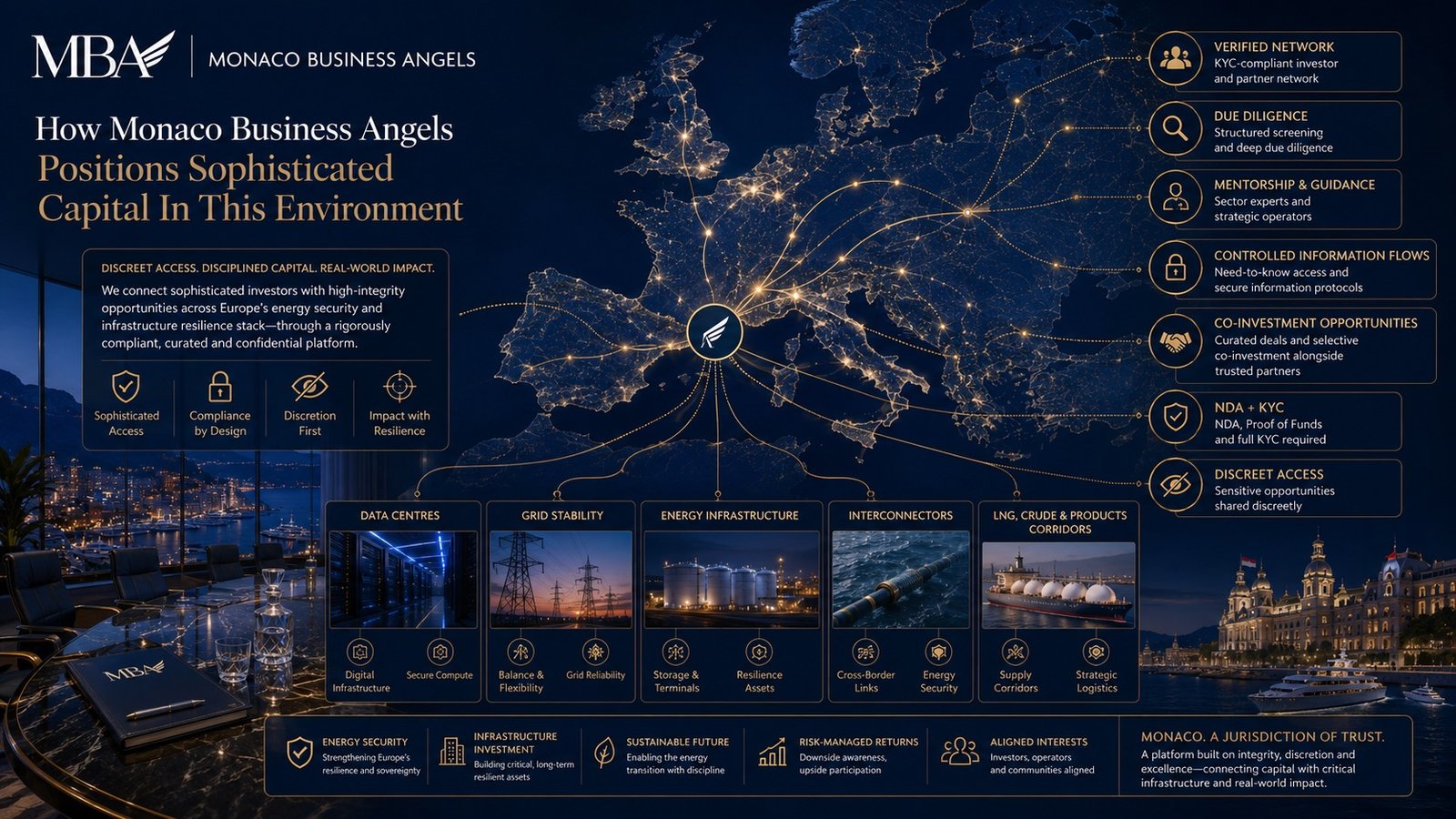
Monaco Business Angels functions as a fully verified, KYC‑compliant network for high‑net‑worth individuals, family offices and experienced private investors. Within the energy and infrastructure sphere, this does not only mean classic oil and gas exposure. It extends to the broader resilience stack:
data‑centre‑related infrastructure linked to grid stability,
environmental and monitoring technology,
grid and interconnector upgrades,
real assets tied to new LNG, crude and product corridors.
Many of these projects sit at the intersection of national interest, regulation and geopolitics. Transactions around strategic ports, regulated storage, midstream assets or climate‑related technologies often require careful legal structuring, patient relationship‑building and a disciplined approach to information.
Monaco Business Angels supports this by combining:
structured screening and due diligence processes suitable for sensitive sectors,
mentorship and guidance for founders and operators,
clear, controlled information flows for investors, all within a strong compliance framework.
For capital ready to step beyond simple listed exposure, the platform can connect investors with co‑investment opportunities alongside larger funds or industrial partners. Some of the most sensitive discussions—around terminals, storage sites, regulated businesses or commodity‑linked land—never appear on public markets. They are addressed only under non‑disclosure agreements, with proof of funds and full KYC in place. In that context, Monaco Business Angels acts as a discreet channel rather than a promotional brand.
The Strategic Imperative That Outlasts Any Single Diplomatic Deal
Europe’s energy security challenge is structural and enduring: no single ceasefire, summit or supply deal can substitute for the physical redundancy that the continent has spent the past three years racing to build.
Ukraine showed that relying on a single dominant supplier can turn pipelines into pressure tools overnight. Hormuz shows that even a friendly supplier base cannot remove the risk of a narrow shipping lane under geopolitical strain. Taken together, they confirm that Europe’s vulnerability lies less in hydrocarbons as such, and more in fragile routes and concentrated infrastructure.
The effective response is physical and structural:
LNG import capacity that can draw from multiple basins;
flexible pipelines and interconnectors that can reverse direction;
upgraded refineries that can process a wider range of crude;
well‑managed storage that buffers seasonal swings;
and sustained investment in renewables, nuclear and efficiency to lower overall import needs.
Diplomatic deals—whether with Russia, Iran or any other actor—can freeze conflicts or reopen channels. They do not build terminals, harden cables or add redundancy to flows.
Markets have a habit of celebrating each ceasefire or summit with a relief rally. Serious capital instead asks a different question: which assets retain relevance and pricing power when the next pipeline, subsea cable or shipping lane comes under stress?
For investors willing to match patience with due diligence, Europe’s current energy‑infrastructure cycle is both large and time‑limited. Those who wish to explore confidential opportunities in this space through Monaco Business Angels will do so only under strict KYC, NDA and proof‑of‑funds procedures, reflecting the sensitivity of the assets involved.
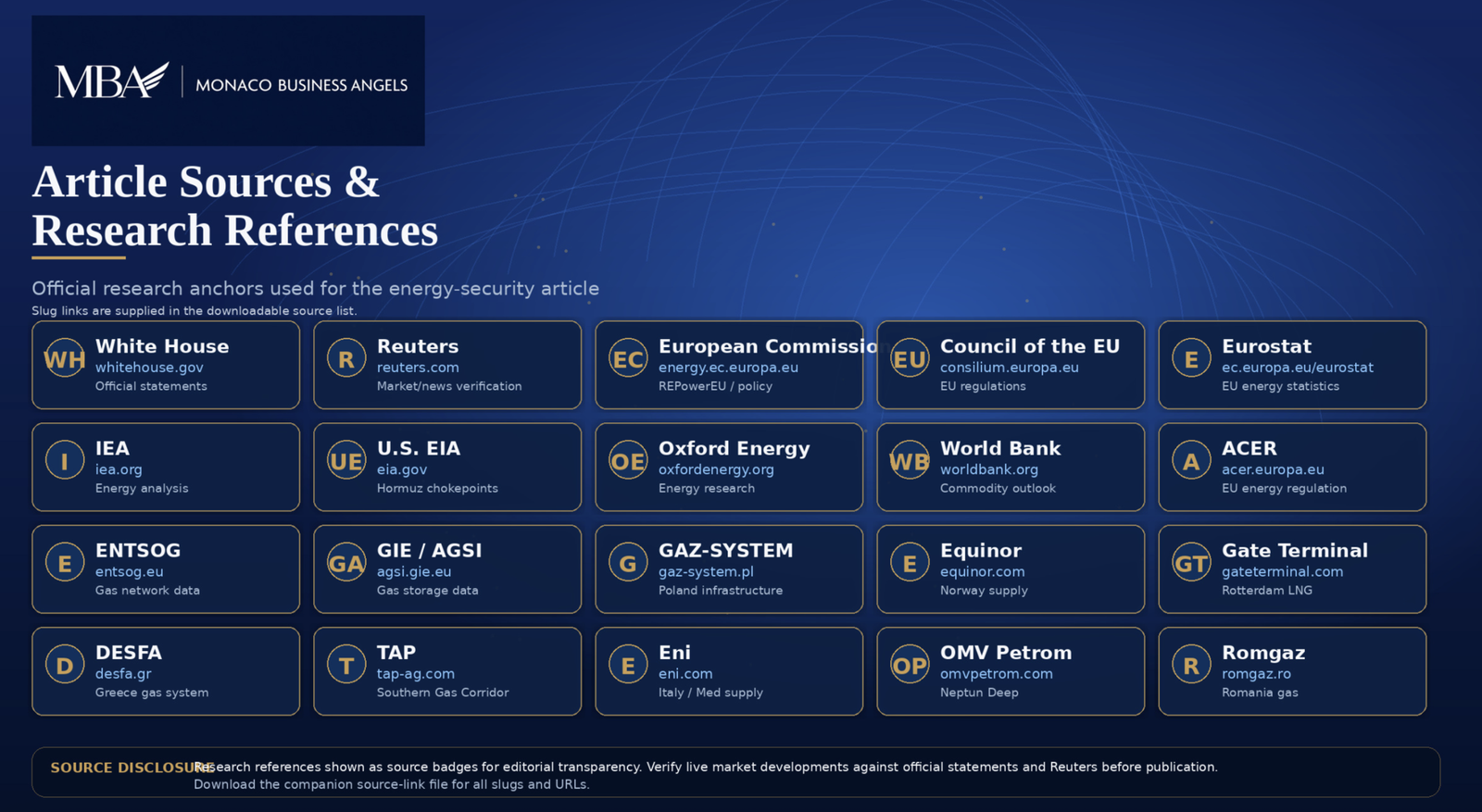
Frequently Asked Questions
Question 1 What is REPowerEU and how has it changed Europe’s gas supply?
REPowerEU is the European Union’s plan, launched in May 2022, to cut dependence on Russian fossil fuels. It combines demand reduction, diversification of suppliers and accelerated renewables. According to the European Commission, EU gas use fell about 19.3% against the prior five‑year average between August 2022 and January 2023, while Russia’s share of imports dropped from roughly 45% to below 14%. More of Europe’s gas now comes from Norway, the United States, Qatar, Algeria and Azerbaijan.
Question 2 How does the Strait of Hormuz affect European LNG supply?
The Strait of Hormuz carries around 20% of global oil and LNG flows each day. Qatar, a main LNG supplier to Europe, sends its cargoes through this route. Any closure or military escalation would raise prices, freight rates and insurance costs for European buyers. The June 2026 ceasefire framework, as reported by Reuters, has reduced near‑term risk and eased premiums but leaves the basic chokepoint exposure unchanged.
Question 3 Which European countries have built new LNG terminals since 2022?
Several states have added or expanded LNG capacity:
Germany moved from zero to several LNG import sites, starting with an FSRU at Wilhelmshaven built in under 200 days.
Poland expanded Świnoujście and benefits from the Baltic Pipe connection to Norway.
Greece increased capacity at Revithoussa and is developing additional floating units.
Italy, the Netherlands and Finland have also added or expanded regasification plants, strengthening regional entry points.
Question 4 Is investing in European gas infrastructure compatible with net zero targets?
Investment in gas infrastructure can fit within net‑zero strategies if assets are efficient, time‑bounded and prepared for future low‑carbon fuels. Many new LNG terminals are designed for later hydrogen or ammonia imports. The International Energy Agency and the European Commission both argue that decarbonisation and energy security can reinforce each other over time. Investors need to assess each project on both its emissions profile and its contribution to system resilience.
Question 5 What role does Norway play in European energy security?
Norway is now the largest pipeline gas supplier to the European Union, covering around half of such imports. Its North Sea and Barents Sea fields, operated by companies such as Equinor, connect directly to terminals in the United Kingdom, Germany and other states. The Baltic Pipe also links Norwegian gas to Poland, strengthening Central and Eastern European security. In addition, Norwegian offshore wind and prospective hydrogen projects are likely to contribute to Europe’s future clean‑energy mix.
Markets may welcome every sign of de‑escalation, from REPowerEU milestones to the Hormuz framework. Serious capital, however, will keep asking the harder question: which assets still matter when the next geopolitical shock arrives?
Interested becoming an Investor? https://monacobusinessangels.com/investors/